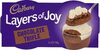
Is Nästagård chokladtårta ultra-processed?

Yes, it's ultra-processed
- 1 Unprocessed
- 2 Kitchen staple
- 3 Processed
- 4 Ultra-processed
Signs of ultra-processing in its ingredients:
- 62 ingredients
- 19 additives
- Nutri-Score E
Less processed dairy desserts


Ingredients
Ultra-processing Processing
socker (processing marker), vatten, grädde, ÄGG, vetemjöl, mandel, kärnmjölkspulver, kokosfett (processing marker), glukossirap (ultra-processing marker), modifierad stärkelse (ultra-processing marker) (e1442 (ultra-processing marker)), potatisstärkelse (processing marker), kakaosmör (processing marker), kakaopulver, invertsockersirap (ultra-processing marker), emulgeringsmedel (ultra-processing marker) (e475 (ultra-processing marker), e471 (ultra-processing marker), e322 (ultra-processing marker), e322 (ultra-processing marker)), bakpulver (e500, e450 (ultra-processing marker)), palmfett, mjölkpulver (processing marker), vetegluten (ultra-processing marker), konserveringsmedel (processing marker) (e211, e202 (processing marker)), skummjölkspulver (processing marker), glukos (ultra-processing marker), färgämnen (ultra-processing marker) (e160a (ultra-processing marker), e101 (ultra-processing marker), e141 (ultra-processing marker), e161b (ultra-processing marker), e120 (ultra-processing marker)), majsstärkelse (processing marker), förtjockningsmedel (ultra-processing marker) (e415 (ultra-processing marker), e420 (ultra-processing marker)), salt (processing marker), maltmjöl (korn), kakaomassa, smör (processing marker), härdat palmfett, fuktighetsbevarande medel (ultra-processing marker) (e1103), vaniljarom (ultra-processing marker), stabiliseringsmedel (e420 (ultra-processing marker)), arom (ultra-processing marker), mjölbehandlingsmedel (e300), enzym, surhetsreglerande medel (e500), ytbehandlingsmedel (ultra-processing marker) (e414 (ultra-processing marker) (baljväxt)), vanillin
Additives: E101 Riboflavin , E1103 Invertase , E120 Cochineal , E141 Copper complexes of chlorophylls and chlorophyllins , E1442 Hydroxypropyl distarch phosphate , E14XX Modified Starch , E160a Carotene , E161b Lutein , E202 Potassium sorbate , E211 Sodium benzoate , E300 Ascorbic acid , E322 Lecithins , E414 Acacia gum , E415 Xanthan gum , E420 Sorbitol , E450 Diphosphates , E471 Mono- and diglycerides of fatty acids , E475 Polyglycerol esters of fatty acids , E500 Sodium carbonates
As written on the pack
socker, vatten, GRÄDDE, ÄGG, VETEMJÖL, MANDEL, KÄRNMJÖLKSPULVER, kokosfett, glukossirap, modifierad stärkelse (E1442), potatisstärkelse, kakaosmör, kakaopulver, invertsockersirap, emulgeringsmedel (E475, E471, E322, E322 (SOJA)), bakpulver (E500, E450), palmfett, MJÖLKPULVER, VETEGLUTEN, konserveringsmedel (E211, E202), SKUMMJÖLKSPULVER, glukos, färgämnen (E160a, E101, E141, E161b, E120), majsstärkelse, förtjockningsmedel (E415, E420), salt, maltmjöl (KORN), kakaomassa, SMÖR, härdat palmfett, fuktighetsbevarande medel (E1103), vaniljarom, stabiliseringsmedel (E420), arom, mjölbehandlingsmedel (E300), enzym, surhetsreglerande medel (E500), ytbehandlingsmedel (E414 (baljväxt)), vanillin. Kan innehålla spår av HASSELNÖTTER
What makes it ultra-processed
Cosmetic additives
Added to change how the food looks, feels or tastes, not to keep it safe. A hallmark of ultra-processed food.
- E101 Riboflavin Colours are substances which add or restore colour in a food, and include natural constituents of foods and natural sources which are normally not consumed as foods as such and not normally used as characteristic ingredients of food.
- E120 Cochineal Carmine is a red colour made from cochineal insects.
- E141 Copper complexes of chlorophylls and chlorophyllins Colours are substances which add or restore colour in a food, and include natural constituents of foods and natural sources which are normally not consumed as foods as such and not normally used as characteristic ingredients of food.
- E1442 Hydroxypropyl distarch phosphate Hydroxypropyl distarch phosphate is a chemically modified starch used to thicken and stabilise desserts, sauces and soups.
- E14xx Modified Starch Modified starches (E1400 to E1452) are starches treated physically, with enzymes or chemically so that they thicken and hold up to heating, freezing or acidity better than ordinary starch.
- E160a Carotene Carotenes are orange-yellow pigments, either synthesised or extracted from carrots, algae or palm oil.
Show 15 more
- E161b Lutein Colours are substances which add or restore colour in a food, and include natural constituents of foods and natural sources which are normally not consumed as foods as such and not normally used as characteristic ingredients of food.
- E322 Lecithins Lecithins are fatty substances extracted mostly from soybeans, sunflower seeds or eggs, used as emulsifiers to keep fat and water mixed, for example in chocolate.
- E414 Acacia gum Gum arabic (acacia gum) is the hardened sap of acacia trees, used to stabilise flavour emulsions in soft drinks and to coat sweets.
- E415 Xanthan gum Xanthan gum is a thickener made by fermenting sugar with the bacterium Xanthomonas campestris.
- E420 Sorbitol Sorbitol is a sugar alcohol used as a sweetener and to keep products moist.
- E450 Diphosphates Diphosphates are phosphate salts used as raising agents in baking powder, and to hold water in processed meats and cheese.
- E471 Mono- and diglycerides of fatty acids Mono- and diglycerides of fatty acids are made from fats and glycerol.
- E475 Polyglycerol esters of fatty acids Emulsifiers are substances which make it possible to form or maintain a homogenous mixture of two or more immiscible phases such as oil and water in a foodstuff.
- Colour Colours are added to restore colour lost in processing or to make a product look more appealing.
- Emulsifier Emulsifiers keep fat and water from separating, giving products a smooth, stable texture over a long shelf life.
- Flavouring Flavourings are concentrated aroma preparations that add or intensify a taste.
- Glazing agent Glazing agents, waxes and shellac for example, coat a surface to make it shiny or stop pieces sticking together.
- Humectant Humectants are substances which prevent foods from drying out by counteracting the effect of an atmosphere having a low degree of humidity, or promote the dissolution of a powder in an aqueous medium.
- Thickener Thickeners, often gums or modified starches, make liquids more viscous so that a product feels richer than its ingredients alone would make it.
- Modified starch Modified starch is starch altered physically, with enzymes or chemically, so that it thickens, gels or survives freezing and heating better than ordinary starch.
Substances rarely used in home kitchens
Refined or extracted in factories, such as syrups made from starch or isolated proteins. The other hallmark of ultra-processed food.
- Glucose Glucose, usually listed as glucose syrup, is cheap, keeps products moist and stops sugar from crystallising.
- Glucose syrup Glucose syrup is cheap, keeps products moist and stops sugar from crystallising.
- Gluten Wheat gluten, sold as "vital wheat gluten", is the protein washed out of wheat flour.
- Invert sugar Invert sugar is ordinary sugar split into glucose and fructose with acid or enzymes.
8 ingredients that would only make it processed
Kitchen staples like sugar, salt and oil. On their own they make a food processed, not ultra-processed.
- E202 Potassium sorbate Preservatives are substances which prolong the shelf-life of foods by protecting them against deterioration caused by micro-organisms and/or which protect against growth of pathogenic micro-organisms.
- Butter Butter, the fat churned from cream.
- Preservative Preservatives slow spoilage by microbes.
- Salt Salt, added for taste and preservation.
- Starch Starch extracted from cereals or potatoes, used to thicken.
- Sugar Sugar refined from sugar cane or beet.
- Vegetable fat Vegetable fats are oils that are solid at room temperature, such as palm or coconut fat.
- Milk powder Milk powder is milk with the water evaporated off: a preserved form of a whole food rather than an industrial extract.
Among 1,413 dairy desserts
From least to most processed, this one ranks 1413th. 72% of the dairy desserts here are ultra-processed.

About this information
- Data from this product on Open Food Facts (barcode 9398470000479, last edited 2 April 2026), available under the Open Database License. If something is wrong or the recipe has changed, you can correct it there.
- Photo: Open Food Facts contributors, CC BY-SA 3.0.
- The NOVA group is an automated estimate from crowdsourced data: a missing or mistyped ingredient can change it.
- NOVA measures processing, not nutrition. For nutrition, Open Food Facts gives this product a Nutri-Score of E (from A, best, to E).
- General information, not medical or dietary advice. Check the pack if you have an allergy.